Showing posts with label affordable nutrition. Show all posts

Thursday, March 5, 2009

Breakfast and the rest of the meals

A big part of eating nutritiously is making sure you don't skip meals and that you make sure to eat breakfast. In Beyond the Bend Nancy Schmieder says it so eloquently with the following:

"It often amazes me how people take better care of their cars than their bodies. I have yet to meet a person who said, “God has a plan as to when my car should ‘die’ and I do not need to worry about it. I don’t need to check or change the oil, or perform any routine maintenance. And I don’t need to worry about the type of gasoline I use.” We recognize the necessity of proper care to get the longest life and best performance out of our automobiles. When will we realize that proper care also gives our bodies the longest life and best performance? "

Did you know that those who skip breakfast have slower reaction times and are more accident-prone. And if you are doing it to control your weight, you're actually countering your actions as those who skip breakfast are actually more prone to gain weight. On top of this, children who skip breakfast have greater hyperactivity, irritability, and anxiety, tend to be more disruptive classroom behavior, have higher rates of tardiness and have a decreased ability to concentrate and solve problems.


Some ideas/ways that we can remember to eat breakfast include:

• Start Small. If your not a breakfast eater, begin with whole wheat toast and/or a piece of fruit. In a few days, add more food.

• Choose Fruit for Breakfast. Fruit gives you fiber. Fresh fruit is the best choice. There are many to choose from: oranges, grapefruits, apples, bananas, grapes, kiwis, mangos, melons, berries. Eat two servings of fruit every morning. Canned fruit packed in juice is also a good choice. Add dried fruit to your cereal.

• Eat High Fiber Hot Cereal. Hot cereal is the best choice, but there are several brands of cold cereal on the market that are high in fiber and low in sugar. Oatmeal is a favorite hot cereal. Try a seven grain cereal and experiment with different grains such as millet, brown rice, quinoa, corn grits for a variety. Try cooking grains in a crock pot overnight and it’s already the next morning. Or cook up a large batch and re-heat the next day. Make your own granola. Add a high fiber cereal to your favorite low fiber cereal. Gradually increase the amount of the high fiber cereal and decrease the amount of the low fiber cereal. For example, if you like cornflakes, add Wheat Chex to the cornflakes. Each morning add a little more Wheat Chex and a little less Cornflakes.

• Choose Whole Grain Bread. Eat two slices of toast in the morning or a whole grain bagel. Spread with fruit spread or applesauce or your favorite nut butter.

• Make Healthy Pancakes or Waffles. Have you ever considered topping your pancakes or waffles with fruit?

• Instead of scramble eggs try scrambled tofu. You’re in for a great surprise.

• The sky’s the limit. The only limitation is your imagination. Make it a priority. Eat breakfast.

Sunday, March 1, 2009

I don't need to-- I exercise


Although some can still manage to have a slim physique because they run a lot, or have a "fast metabolism" that should be no excuse to not eat healthy. Nutrition isn't important just to look good, but to feel good and is a great way to compliment your exercise routine--in fact eating well should be even more incentive as you will probably need an increased intake of carbohydrates and protein.

About.com discusses ways that you can get this extra needed nutrition and outlines it by when normally do your work outs. For example, if you like to work out in the mornings it suggests that you try eating, bagels, raisins, bananas, or a liquid meal like a sports drink.


Other things to take into consideration are the extra hydration that you will need. The American College of Sports Medicine (ACSM) suggests that when you work out you need more water and you need to drink around 16 oz of water two hours before your workout for optimum performance and sip water throughout your program.

Wednesday, January 14, 2009

It's Too Expensive


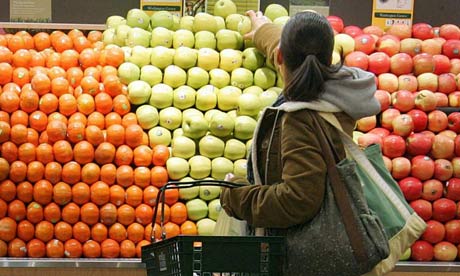
Everyone knows health food = expensive

"University of Washington researchers found when they compared the prices of 370 foods sold at supermarkets in the Seattle area. Calorie for calorie, junk foods not only cost less than fruits and vegetables, but junk food prices also are less likely to rise as a result of inflation."

When you can eat more calories for less money, especially when you are strapped for cash, why would you buy healthier foods? Possibly because of the way that a healthy lifestyle saves you in the long run, as your risk for obesity decreases and along with that your risk for chronic diseases drop as well.

This is a comforting fact considering chronic disease facts such as:

  • The medical care costs of people with chronic diseases account for more than 75% of the nation’s $2 trillion medical care costs.
  • The direct and indirect costs of diabetes is $174 billion a year.
  • Each year, arthritis results in estimated medical care costs of nearly $81 billion, and estimated total costs (medical care and lost productivity) of $128 billion.
  • The estimated direct and indirect costs associated with smoking exceed $193 billion annually.
  • In 2008, the cost of heart disease and stroke in the U.S. is projected to be $448 billion.
  • The estimated total costs of obesity was nearly $117 billion in 2000.
  • Cancer costs the nation an estimated $89 billion annually in direct medical costs.
  • Nearly $98.6 billion is spent on dental services each year.
So how is it done?

There are lots of great ideas to help you reduce food costs without losing nutrition. Divine Caroline provides her list of 20 healthy food items for under $1, a deal you can't beat and with some items that aren't typical of the American diet, you can get creative with your cooking.

Rebecca Pratt also details some ways you can eat healthy on a budget, such as:
  • Drink lots of water (at least 8 cups a day)
  • Limit salty and sugary foods
  • Avoid eating many foods that are high in saturated fats
  • Make “variety” the watchword of your eating
  • Set aside a regular block of time to plan your meals (include snacks)
  • Stock up on healthy, but cheaper items-- such as beans, lentils, pastas, rice
  • You can cook large quantities and then freeze extras
  • Buy in bulk, but only things that make sense, vegetables or fruits that will go bad quickly are not the best bulk item

Now it's your turn, what are ways that you find to decrease the cost of your groceries without decreasing your health?

No Time

One of the most common reasons in our technology driven world that people don't cook healthy is that they don't have any time. Between school, family, social life, and everything else that fills our agendas, how is it possible to find time to prepare a healthy meal?

Another issue to address is: Are fast food restaurants really that bad for me?

If you have ever seen "Super Size Me" I'm sure your first knee-jerk reaction to this question would be an automatic "YES!" Consider the facts:
  • most fast food restaurants fry a majority of their food and you can bet on almost anything from a fast food joint to have at least twice as many calories as something made at home
  • serving sizes in fast food restaurants do not match up with suggested serving sizes from
  • "Some scientists are starting to believe that binging on foods that are excessively high in fat and sugar can cause changes to your brain and body that make it hard to say no. A few even believe that the foods can trigger changes that are similar to full-blown addiction."(Martindale 2003)
However, with one out of four Americans eating out every day, it would be near impossible to try and tell everyone the solution is just to not eat out. Instead we need to realize that it is still possible to make wise, healthy decisions when you eat out.